
What actually happened at the global box office
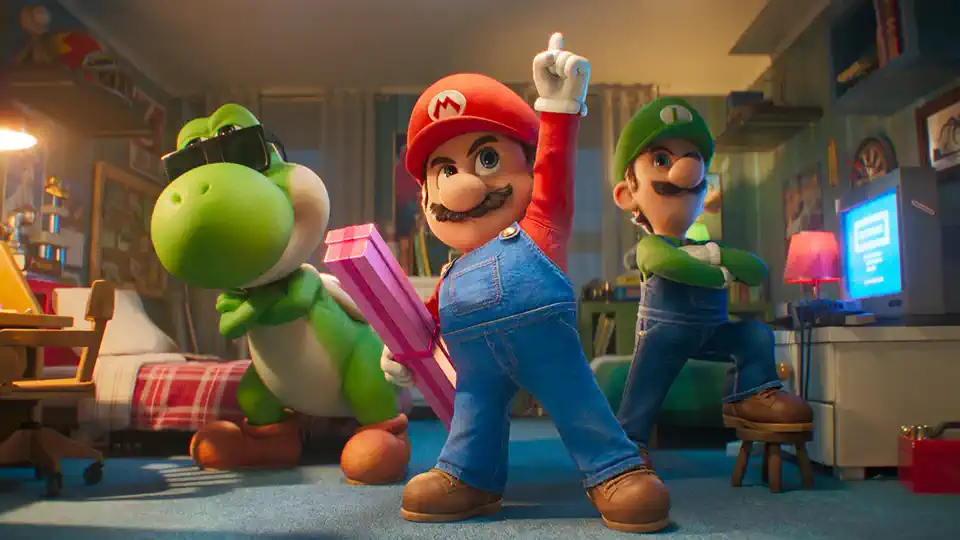
The Super Mario Galaxy Movie crossed $1 billion in global ticket sales in its tenth weekend of release, finishing the milestone on $428.5 million domestic and $571.5 million international and becoming the first 2026 release to hit the threshold. The Hollywood Reporter documented the milestone, the $110 million production budget, and the staying-power trajectory that allowed the film to convert ten consecutive weekends of theatrical hold.
Universal, Illumination, and Nintendo's production is the year's top-grossing film and currently sits ninth on the all-time animated chart at $2.3 billion across the two-film Mario series. The voice cast – Chris Pratt, Anya Taylor-Joy, Charlie Day, Keegan-Michael Key, Jack Black, plus newcomers Donald Glover, Glen Powell, and Benny Safdie – was already a marketing asset, but the financial story belongs to the production economics.
Why a $110M budget hitting $1B matters more than the headline number
The 2026 box office has produced exactly one film this year that has crossed a billion globally, and it cost roughly the same as a single mid-budget Marvel reshoot package. That ratio – 9x production budget recovery in theatrical only, before licensing and ancillary – is the metric that should be guiding studio greenlight conversations for the next twelve months.
By comparison, this year's live-action tentpoles are running closer to $200-300M in production cost with global ceilings under $600M. The math is no longer subtle. Animation is producing the year's highest-margin theatrical assets, and the gap between animation profitability and live-action profitability has widened, not narrowed, since the 2023 streaming pullback.
The tenth-weekend hold is the truly unusual data point
Modern theatrical releases live or die in their first three weekends. Animation can sometimes stretch that to five or six. A film posting incremental gains into a tenth weekend is the kind of theatrical behavior the post-pandemic market was supposed to have killed.
What enabled the hold here is the family-repeat economy. Families take children to the same film two or three times across a summer, and the film becomes a recurring weekend activity rather than a single ticket purchase. Galaxy Movie engineered that pattern deliberately by spacing its merch drops, soundtrack releases, and IMAX expansions to give audiences a fresh reason to return at week five and week eight.
What this signals for the rest of the summer release slate
Studios that have already committed to live-action tentpoles for July and August will be watching Galaxy Movie's continued hold with a different question now: not whether they can match it, but whether they should reposition their own marketing to assume the family audience may already be back in theaters with this film weekly through Labor Day.
Animation calendars have historically been gentler – fewer releases, longer runways, less direct competition. That cushion is collapsing as more studios chase the math Galaxy Movie just demonstrated. The 2027 release calendar is already shifting toward more animation slots, and this milestone will accelerate that move.
The verdict on what the $1B milestone really proves
The strongest takeaway is that the Mario franchise is no longer just a Nintendo brand monetization. It is a working theatrical engine that has now produced two billion-dollar features on disciplined budgets, and the system is repeatable.
The contrarian read is that Galaxy Movie's billion-dollar moment is less an animation story than a structural verdict on how the 2026 theatrical year is going to be remembered. Live-action will produce most of the cultural conversation. Animation will produce most of the actual money, and that asymmetry is the real headline.