Madonna's Surprise Times Square Pride Concert with Grindr Functions as the Most Calculated Album Rollout of Her Late Career
What actually happened at The Square on June 4
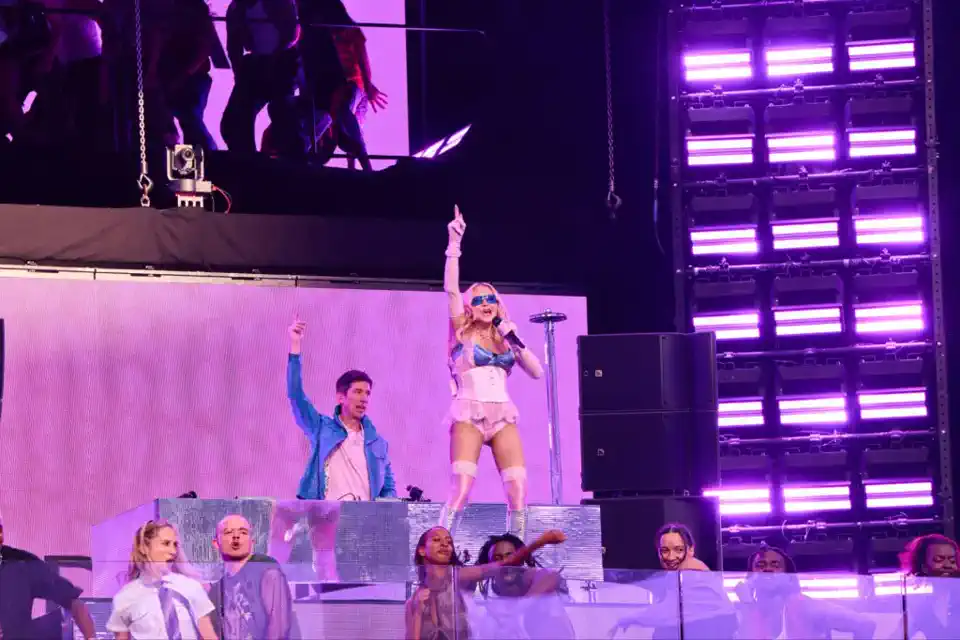
Madonna and Grindr staged a surprise 18-minute pop-up concert in Times Square on the evening of Thursday, June 4, 2026. Billboard described the performance as the public unveiling of "The Square," a hidden venue at the corner of West 47th and Seventh whose walls fold inward to reveal a stage.
The set leaned heavily on her upcoming album, drawing on tracks including "I Feel So Free," "Bring Your Love," "Love Sensation," "Get Together," "I Love New York" and a closing run through "Hung Up" that anchored the new material against the catalog her core audience already trusts.
Why the Grindr partnership is more strategic than it looks
Most pop concerts paired with brand activations involve consumer goods, streamers, or beverage sponsors. The Grindr alignment lets Madonna preserve her LGBTQ+ historical authority while delivering an album rollout that does not feel forced through the standard label PR cycle or a tour-sponsor template.
The choice signals where she is putting her cultural weight ahead of the July 3 release of "Confessions II" – back into the communities that made the original "Confessions on a Dance Floor" a 2005 phenomenon. That history is part of the album's positioning, and the venue choice protected it from feeling like a corporate stunt.
The venue itself is the headline
A surprise concert is no longer surprising in 2026. The architectural twist is what made this particular story travel. The Square's reveal turned a city block into an unboxing moment at urban scale, and that mechanic gave the imagery a half-life beyond the night itself.
Even Madonna's most prolific touring competitors do not have access to a venue that can be hidden in plain sight until showtime. The result was a stage moment the audience cannot dismiss as routine – which is the entire battle for any legacy act trying to introduce new material in a feed-driven attention economy.
Why the rollout signals a recalibrated late-career strategy
Madonna spent the last two years on stadium-scale legacy touring built around catalog. Pivoting to a pop-up format, with new material rather than greatest hits, reframes her current era around the present rather than the back catalog. That is a meaningfully different positioning than the Celebration tour conveyed.
The contrast between the production scale (massive, architectural, technically complex) and the actual runtime (eighteen minutes) gave the moment more replay value than a full headline set would have produced. Short, dense, hard to recreate – exactly the format an algorithmic feed rewards.
What this means for Confessions II and the July rollout
The Times Square set functioned as the first measurable engagement test for the new material with the audience whose reaction will define the album's early performance. The fact that the activation was explicitly Pride-coded keeps the conversation tied to the album's communal, danceable identity rather than chart speculation.
The contrarian read is that Madonna does not need a chart number to remake her current era. She needs cultural participation. By aligning the rollout with Pride Month and a venue stunt, she compressed both into one night and gave herself a month-long talking point before the album drops on July 3.